
Europe has the diagnosis. Execution is missing
12 May 2026

Europe has the diagnosis. Execution is missing.
ICC Netherlands General Assembly 2026: four voices on competitiveness, AI, energy and MedTech – and the one challenge they all converge on
Twenty months after the Draghi Report identified Europe’s competitiveness problems, just 11.2% of its 176 recommendations have been implemented. The Wennink Report has since translated the same diagnosis into a Dutch context – current growth of 0.5 to 0.9% against the 1.5 to 2.0% needed to keep the economy on track. All in all, the members, partners and policy voices convening at ICC Netherlands annual General Assembly on 6 May 2026 had enough to talk about.

The theme of the day was deliberately provocative: can Europe keep up? The answer that emerged across four very different presentations was the same. Europe is not short of diagnosis: it’s short of delivery.To explore why, the Assembly brought together four voices from different facets of the European business and policy conversation. Paul Verhagen, lecturer at the University of Amsterdam, on technology and geopolitics. John Müller, IT Director of AI Engineering at ING, on the AI race. Norbert Both, partner at Publieke Zaken and a former diplomat and Shell executive, on energy. Thomas Leenders, Head of Government and Public Affairs Benelux at Philips, on MedTech and the Wennink Growth Plan. ICC Global Deputy Director Andrew Wilson, joining from Paris, closed with a global perspective.
A new strategic map
Paul Verhagen opened with the harshest framing of the day. Europe faces three simultaneous threats: militarily vulnerable to Russia, economically exposed to China, and increasingly held hostage technologically by the United States. “Our oldest ally is now acting more and more like an enemy,” he said. The neoliberal era that shaped European business was, he argued, never a product of pure market forces; it was underwritten by cheap Russian energy, American security and American technology.
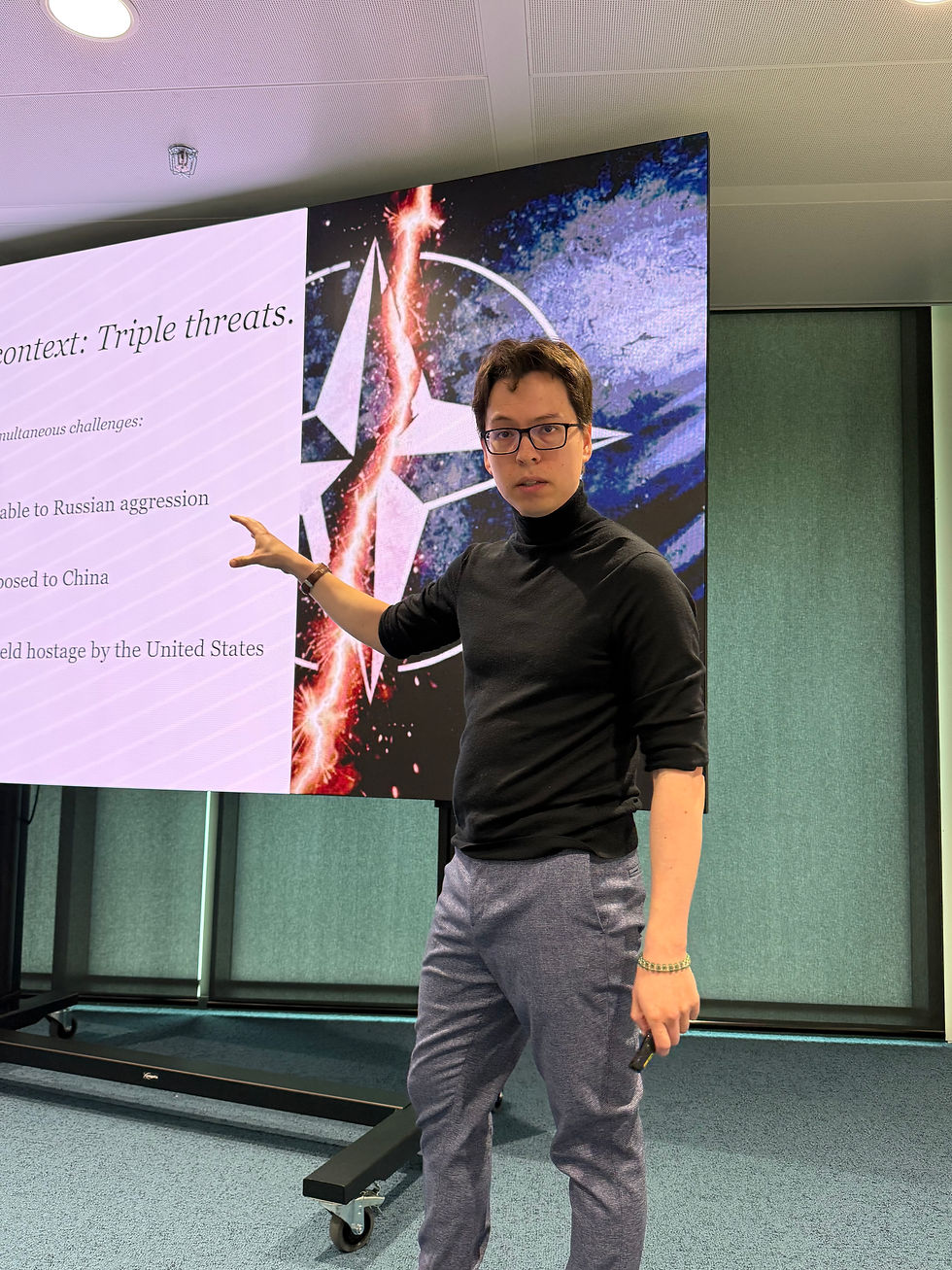
The pragmatic conclusion of his message is uncomfortable: Europe should pivot toward China for the things it now needs the most. China has won the EV race, he argued; Europe should drop its tariffs on Chinese electric vehicles, buy them at scale, and free European industrial capacity for what Europe still has to build for itself – including for defence purposes. In exchange, Europe should leverage what China badly wants and needs: access to ASML’s EUV machines, traded for rare-earth elements and Chinese cooperation on Ukraine.
The trade-off is morally costly, he conceded. “What you’re saying is you’re going to trade Taiwan for EUV. That is what it means.” The strategic priority for Europe, in his view, is Ukraine over Taiwan.
His positive model is what he called a garden with high walls – internal European market competition behind tariffs protecting strategically vital sectors. “Mutual dependence becomes a transaction,” he said. “Where it helps us, we use it. Where it hurts us, you cut it like the weed that it is.”
Beneath the provocations was the diagnosis the day kept returning to. “We have the Chips Act. We have the Green New Deal. We have the Mining Act. And we have the AI Act. We’re trying to do all these things at the same time,” he said. “This sounds like megalomania – because it is.” He drew the comparison to the Meiji Restoration: in the 19th century, watching the Qing Dynasty dismantled, Japan sent emissaries to learn where European strength came from – and rebuilt its institutions accordingly. Europe today, he argued, needs to ask the same question of others.
The AI gap
John Müller moved the discussion from grand strategy to the engineering floor. ING’s AI lead with fifteen years in the field, he is part of the small group of European practitioners who have seen the technology evolve both before and after ChatGPT – and who now have to make hard procurement decisions on the back of that knowledge.
“There is only one superpower in AI right now,” he said. The US outspent the EU more than five-to-one on AI in 2024, and some analysts expect a further 44% rise in investment in 2026. The structural risk, he argued, is not just spending volume but dependency. “Most of you,” he reminded the audience, “won’t be able to log in to your computer if Microsoft turns off its ID service.” The US hyperscalers, in his framing, are no longer just companies. “You need to start looking at them as essentially central banks for the digital economy, not just as corporate entities.”

He laid out four scenarios available to Europe – each with a serious downside. Keep leaning on US cloud providers? Accept the structural dependency, and notice that even the hyperscalers are starting to ration capacity. Use European cloud alternatives instead? “They’re years behind. If the first one goes down, everything goes down.” Build it all yourself with open-source tooling? Your most valuable engineers stop working on the business that pays them. Make a big bet on a single European champion? Just hope you choose the right one.
Müller closed not with an answer but with a question for the audience: which silver bullet are you willing to choose? It was the most uncomfortable moment of the afternoon. No scenario was the safe option – and every Dutch business in the room is, in some form, already making the choice.
From PetroStates to ElectroStates
Where Verhagen and Müller pushed toward decisive choices, Norbert Both argued for something less dramatic but harder: Europe getting its own house in order before deciding who to lean on next.
“There is no place on earth that can be fully self-sufficient,” he said. “Europe will always be an energy importer – in the fossil system, and in the new electrified one.” The question, for him, is not how to escape dependency but how to manage it: build optionality, redundancy, and diversified suppliers. He reached for a household analogy. “Different shoes for different occasions – and so it is with energy.”
Both reframed the global picture as a shift from PetroStates, which control oil and gas, to ElectroStates, which control critical minerals and the processing capacity behind them. China dominates the second category almost entirely. The infrastructure wave behind it is colossal: quoting NVIDIA’s Jensen Huang, he reminded the audience that AI represents “the biggest infrastructure build-out in human history” – roughly a doubling of electricity demand for data centres over the next five to seven years, “the equivalent of adding Germany’s entire electricity system.”
The Dutch side of that build-out is sobering. Citing Tennet, he noted that the Netherlands alone will need around 100,000 kilometres of additional cable, 50,000 new transport stations, 670 high- and mid-voltage substations, and 30,000 additional technicians – taking up a footprint equivalent to 11,000 football pitches. “And still I hear politicians and senior civil servants say: we just need to electrify the system. Fine. But be honest about the scale.”

There is a fossil side of the story that has gone quiet too. Europe has reduced its refinery capacity ten years in a row, leaving a direct import dependency of 25 to 30% on jet fuel. Sustainable aviation fuel will help, but “even if it’s produced, it will still be based on imported methanol – and the biggest producer of green methanol is China. Same choke points, same dependencies.”
His call was for humility, then action. “Speak softly and carry a big stick,” he said. “Get your act together. And don’t use big words when you know you are dependent.” His most provocative proposal: where the business case for energy security is disappearing – refineries, gas storages, coal-and gas-fired power stations – the state should be willing to step in and spend money to keep these assets available for when society needs them up and running. “Corporates won’t pay that bill.”
From plan to execution
If the geopolitics panel framed the challenge, Thomas Leenders described what execution can look like in practice. Philips contributed to both the Wennink Report and the resulting MedTech Growth Plan – a roadmap shaped by more than a thousand stakeholders and aimed at positioning the Netherlands among the world’s top three MedTech ecosystems, and number one in Europe, by 2035.

The numbers behind the ambition are concrete: around 30,000 MedTech jobs in the Netherlands today, with potential for 11,000 more; €5 billion in additional annual export value by 2035; over €22 billion in potential healthcare cost savings through digitisation and AI; and more than 75 new start-ups and scale-ups already on the horizon. Philips alone invests €650 million a year in Dutch R&D – 40% of its total worldwide R&D spend – and employs around 4,000 people at its Best location, where the Assembly was held.
But Leenders was clear that ambition is the easy part. “We see in the Draghi Report a lot of good plans, but no execution,” he said. “This plan must be different. Otherwise, after six, eight or twelve months, it’s still only a plan – and then it becomes a problem in five or ten years’ time.”
His proposal for delivery was tangible. The plan calls for a government structure with twenty programme leaders per domain, and a triple-helix approach binding industry, science and government together from day one. He pointed to the Dutch ministerial task force already being assembled – led from the Prime Minister’s office in partnership with the Ministry of Economic Affairs – as the kind of structure that could make the difference between a plan that delivers and a plan that becomes a footnote of history.
Four priorities, one challenge
Closing the panel, Andrew Wilson zoomed back out. Brussels’ problem, he argued, is not a lack of ideas but a lack of focus. Europe tries to do everything at once and rarely converges on the four or five things that matter most. From a Brussels vantage point, he sketched what those priorities might be.
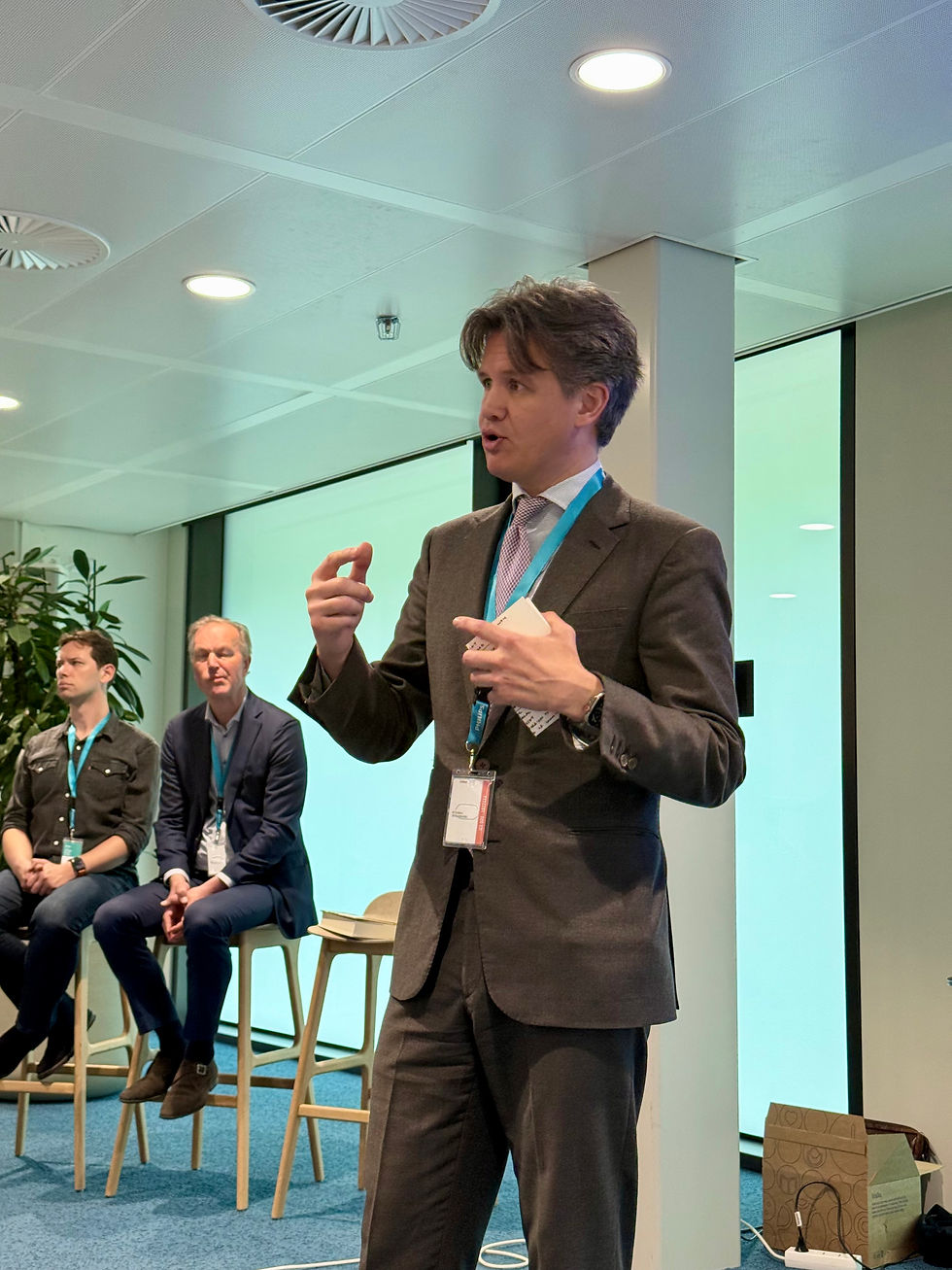
First, China: Europe needs a coherent collective view of its most important external relationship. Second, AI and the future of work: Europe must move past a defensive, regulatory-first posture and engage strategically. Third, the Single Market, particularly services, where reform has been promised for more than twenty years and is still incomplete. Fourth, energy markets: competitiveness rests on industrial energy costs that today are simply unworkable.
The 11.2% Draghi implementation figure, he conceded, may be a little unfair as a headline. “But the direction of travel,” he said, “is unmistakable. “Europe’s weakness is no longer in diagnosis. It is in delivery.” And delivery, in his view, will not come from the European Commission alone. “Business will have to step into the conversation.”
Where ICC Netherlands fits in
Which is where ICC Netherlands sees its role. For Director General Laure Jacquier, the Assembly’s discussion underlined exactly why the organisation matters now. “The global rulebook is being rewritten in real time,” she said. “Our role is to make sure Dutch businesses are at the table where that happens – bringing practical experience into global rule-making, and translating global complexity into something boards can act on.”

The Assembly closed with the formal business of the year and a reminder of ICC Netherlands’ five strategic priorities for 2024–2026: multilateralism and trade, business integrity, dispute resolution, sustainability and inclusive leadership, and digital trade. The conversation continued over drinks among Philips’ medical technology – a fitting reminder that the question of whether Europe can keep up is, in the end, a question about what its companies will choose to build, deliver and stand for next.