Boards under the microscope: from compliance to ethical stewardship
27 Feb 2026

Boards Under the Microscope: From Compliance to Ethical Stewardship
On 27 February 2026, ICC Netherlands hosted the 12th Ethics & Compliance Observatory Group Meeting at our offices in The Hague. The morning brought together compliance leaders, board advisors, recruiters and governance experts for a focused discussion on a question many organisations are currently grappling with: how can ethics and compliance move from a defensive control function to a strategic force shaping boardroom decision-making?
While ICC Netherlands briefly introduced its broader work, including our efforts to connect standards with impact and our Week of Integrity initiative, the heart of the meeting lay in two substantive conversations: a panel on the evolving compliance function and a keynote on how boards should oversee ethics.
What emerged was a clear message: the future of ethics is not technical. It is structural, cultural and deeply connected to governance.
Compliance as a Strategic Function: Beyond the “Checkbox”
The first panel, moderated by Andrea Cardoso, explored how compliance is changing in practice and in the labour market. Bringing together perspectives from industry and executive search, the discussion highlighted a profound shift in expectations.
Compliance is no longer perceived as a back-office “checkbox” function. C-level leaders increasingly expect strategic input. Boards expect foresight. Business teams expect partnership.
Three themes stood out.
The Skillset Is Expanding
Technical knowledge remains essential. Professionals must understand regulatory developments in areas such as AI, ESG, sanctions, and geopolitical risk. However, the panel emphasised that soft skills are now decisive.
Bridge-building, stakeholder management and the ability to translate complex risk into business-relevant language were described as core capabilities. Compliance leaders who succeed are those who can sit at the table early in a project, not only at the end when something goes wrong.
In other words, credibility is built through enabling the business, not blocking it.
Talent Shortages and Changing Profiles
Recruitment data presented during the discussion showed a noticeable gap in mid-level compliance professionals with five to ten years of experience. At the same time, backgrounds are diversifying. The function is no longer dominated exclusively by lawyers; professionals now come from finance, data, behavioural science and operational roles.
AI is also reshaping entry-level roles. As routine tasks become automated, junior compliance professionals are expected to contribute more analytical and advisory value from the outset.
This evolution raises an important question for boards: are we investing in the right competencies for the risks we face?
Central Oversight vs. Local Autonomy
In global organisations, tension persists between centralised policy-making and local implementation. The panel reflected on the need to balance consistency with contextual sensitivity. Cultural differences, including differing perceptions of practices such as nepotism or gift-giving, complicate the picture.
The conclusion was pragmatic: effective compliance culture is built through relationships. Early engagement with local business leaders, understanding operational realities, and empowering them to take ownership of decisions strengthens both integrity and performance.
Compliance, therefore, is not merely about rules. It is about trust.
How Boards Should Oversee Ethics: From Aspiration to Practice
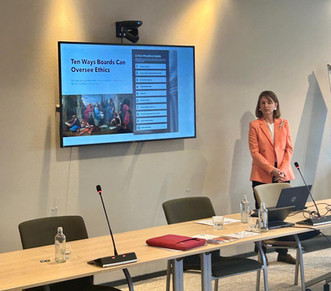
If the panel addressed the “how” of compliance in organisations, the keynote by Vera Cherepanova, Director of Boards of the Future, addressed the “who”, the board itself .
Her presentation was grounded in the How Boards Should Oversee Ethics: A Ten-Practice Guide for Modern Boards. The document, outlined on pages 1 and 5 of the guide, sets out ten concrete practices designed to embed ethics into governance rather than treat it as an afterthought.
The tone was clear: ethics must evolve from a “nice-to-have” add-on into a core operating system for modern boards.
Several practices resonated strongly with participants.
Ask Better Questions
One of the most compelling concepts introduced was FOFO, the “fear of finding out”. Boards often receive polished reports and may hesitate to probe further. Yet corporate scandals rarely arise from unknown risks; they emerge from known issues left unexplored.
Curiosity requires courage. Boards must move beyond rehearsed answers and formulate questions that challenge assumptions. Ethics oversight begins not with additional reporting, but with better inquiry.
Oversee Culture, Starting with the Board’s Own
The guide emphasises that culture is no longer a “soft” topic. It is measurable, strategic and directly linked to enterprise value. However, before evaluating management’s culture, boards must examine their own dynamics.
How are dissenting views handled? Is debate encouraged? Are uncomfortable issues addressed openly?
Board culture shapes organisational culture. The mirror effect cannot be ignored.
Look Beyond the Numbers
Financial expertise remains central to governance, but the guide cautions against “arithmocracy”, the dominance of numbers without narrative. Many of today’s most consequential risks sit outside financial statements until they crystallise into crises.
Boards must therefore interrogate not only what the data shows, but why it shows it. Every debate may start with figures, but it ends with values and consequences.
Set the Conditions for Speak-Up
Whistleblowers were described as critical early-warning systems.
Too few reports can be as concerning as too many. The board has a unique role in ensuring that reporting mechanisms are credible, protective and genuinely accessible.
Importantly, psychological safety must be real, not performative. Artificial harmony, where everyone is polite but no one is honest, is a governance risk in itself.
Bring in the Right Expertise
A particularly practical recommendation concerns board composition. If ethics, risk and compliance expertise is absent, boards should add it or establish interim advisory mechanisms. Modern risk landscapes require modern competencies.
This is not diversity for symbolism. It is alignment between risk exposure and oversight capability.
Practice Stewardship
Finally, the guide reframes the board’s legal discretion. Corporate law gives directors significant latitude under the business judgment rule. The central question is therefore not what boards must do, but what they choose to do with that discretion.
Stewardship becomes the ultimate test of ethical governance.
Ethics in a Time of Polycrisis
The broader context underlying the discussion was what the guide describes as “polycrisis”, technological shocks, geopolitical volatility, leadership misconduct and societal distrust. These forces expose thin ethical oversight structures.
At the same time, regulatory frameworks often treat ethics as a defence mechanism. Compliance becomes a shield rather than a compass.
The Observatory meeting challenged that framing. Ethics is not about reducing liability alone. It is about improving decision quality.
Boards that integrate curiosity, culture assessment, foresight and structured debate are better positioned to navigate uncertainty. Compliance leaders who speak the language of strategy are more likely to influence outcomes.
From Reporting to Informing
A subtle but powerful shift was discussed throughout the morning: moving from reporting to informing.
Reporting is backward-looking and often technical. Informing is forward-looking and strategic. It shapes discussion rather than merely documenting it.
For ethics and compliance leaders, this shift requires confidence and influence tactics. For boards, it requires openness to engage beyond financial metrics.
For organisations, it offers resilience.
The 12th Ethics & Compliance Observatory Group Meeting reaffirmed ICC Netherlands’ commitment to providing a neutral platform where business leaders, governance experts and compliance professionals can engage in substantive dialogue.
Ethical oversight is no longer peripheral. It sits at the centre of sustainable value creation.
The question is not whether boards will address ethics. It is how rigorously, and how courageously, they will do so.