
Two ICC signals on AI: a practical guide for SMEs, and a global business voice for the UN
6 Jul 2026
Two ICC signals on AI: a practical guide for SMEs, and a global business voice for the UN
ICC has released a Self-Assessment Guide for responsible AI adoption, and coordinated the joint business contribution to the first UN Global Dialogue on AI Governance.
Two moves from ICC in recent weeks show how business is stepping into the AI governance conversation, from the boardroom of an SME to the multilateral table.
A practical framework for SMEs
The ICC AI Self-Assessment Guide, released in June, is a question-based framework that helps businesses using or developing AI to ask the right questions, identify key risks, and take proportionate steps toward responsible AI adoption.
Its primary audience is small and medium-sized enterprises, and the reason is a real one. SMEs are adopting AI more slowly than larger companies despite the growing availability of tools. When they do use AI, adoption is often ad hoc and informal, without a company-wide strategy or safeguards. Existing AI resources tend to be either too abstract for practical use or too technical and legalistic for teams without dedicated legal or IT expertise. The Guide is written in plain language to close that gap.
It covers the four areas where SMEs are most exposed: contract coverage, data protection, confidential business information, and internal governance and processes. Users work through a self-assessment checklist that surfaces potential compliance gaps and provides clear, actionable recommendations. The intent is to build "AI readiness" across core business functions so that SMEs can adopt AI with the same confidence larger companies have, without the same overhead. Larger organisations can also use the Guide as an internal awareness and training tool.
For Dutch business, and particularly for the SMEs that make up the backbone of Dutch exports, the Guide is exactly the kind of resource that turns AI governance from a policy topic into an operational one. It is not a comprehensive legal assessment of AI-related obligations. It is a practical starting point.
A joint business voice at the UN
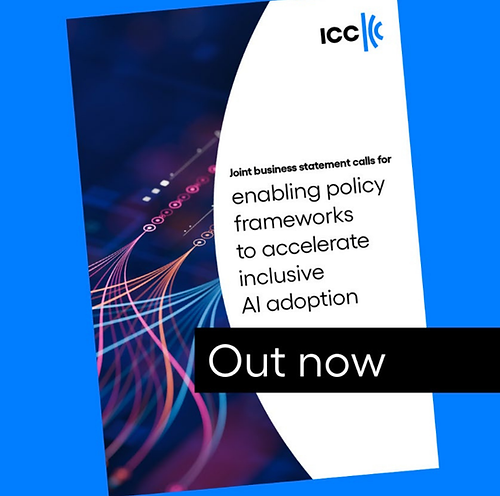
The second signal is a policy contribution. On 6 July 2026, ICC coordinated a Joint Business Statement as its contribution to the inaugural UN Global Dialogue on AI Governance in Geneva. Developed with contributions from ICC's global membership, National Committees and partner industry associations, the Statement brings together cross-sector business perspectives and recommendations on the policy, infrastructure, skills and governance conditions needed to accelerate inclusive AI adoption worldwide.
The message from business is direct: access to AI technology alone is not enough.
Realising AI's potential depends on strong foundations across infrastructure, skills, governance, innovation, and access to high-quality data.
The Statement calls on governments to focus on seven priorities:
Invest in the foundations of AI adoption: sustainable energy, connectivity including broadband and fibre networks, data centres and cloud infrastructure.
Support high-quality data ecosystems and expand access to compute resources, with governance frameworks that enable cross-border data flows and responsible data use while protecting privacy, security and IP.
Prioritise skills and capacity-building, from AI literacy to digital and technical training.
Strengthen local innovation ecosystems for start-ups, SMEs, researchers and entrepreneurs.
Promote enabling and interoperable policy frameworks that are risk-based, proportionate, technology-neutral and flexible enough to evolve alongside technological progress.
Advance trust and safety through aligned evaluation methods, transparency, disclosure practices and user redress.
Deepen public-private collaboration as the vehicle for scaling inclusive impact.
For a Dutch business community that is deeply international, the Statement matters on two levels. It signals what global business, speaking as a whole, is asking of governments on AI, which is a useful benchmark for the conversations Dutch companies are having with policymakers domestically. And it reinforces that the answers on AI governance will need to be interoperable across jurisdictions, not fragmented, if AI is to deliver on its promise across borders and business sizes.
Both signals point in the same direction
Together, the Guide and the Statement send a coherent message. AI is moving faster than the governance around it, and closing that gap will take practical tools for individual businesses and enabling frameworks from governments. Both feed directly into ICC Netherlands' 2026 theme of integrity in a digital age. As Professor Sam Solaimani argued in our recent piece for the newsletter, integrity is not the brake on digital innovation. It is the steering system.
The Guide gives Dutch business a tool it can pick up today. The Joint Business Statement ensures that business voice shapes the rules that follow.
Read the AI Self-Assessment Guide → https://iccwbo.org/news-publications/guide/ai-self-assessment-guide-helping-businesses-assess-ai-compliance-ip-protection-and-risk/
Read the Joint Business Statement → https://iccwbo.org/news-publications/news/joint-business-statement-calls-for-enabling-policy-frameworks-to-accelerate-inclusive-ai-adoption/