The end of the neoliberal era
Tom Scott
1 Sept 2026

Paul Verhagen is not easy to place. Dutch-American-Chinese by background, trained in theoretical physics, philosophy, energy policy and artificial intelligence, and now teaching sociology at University of Amsterdam while researching AI-related inequality and technological change – it’s fair to say that he doesn’t have a standard vantage point of the world. And that is exactly why we wanted to interview him for this ICC Netherlands newsletter. In addition, you may remember him as being one of the guest speakers at the ICC Netherlands General Assembly back in May.
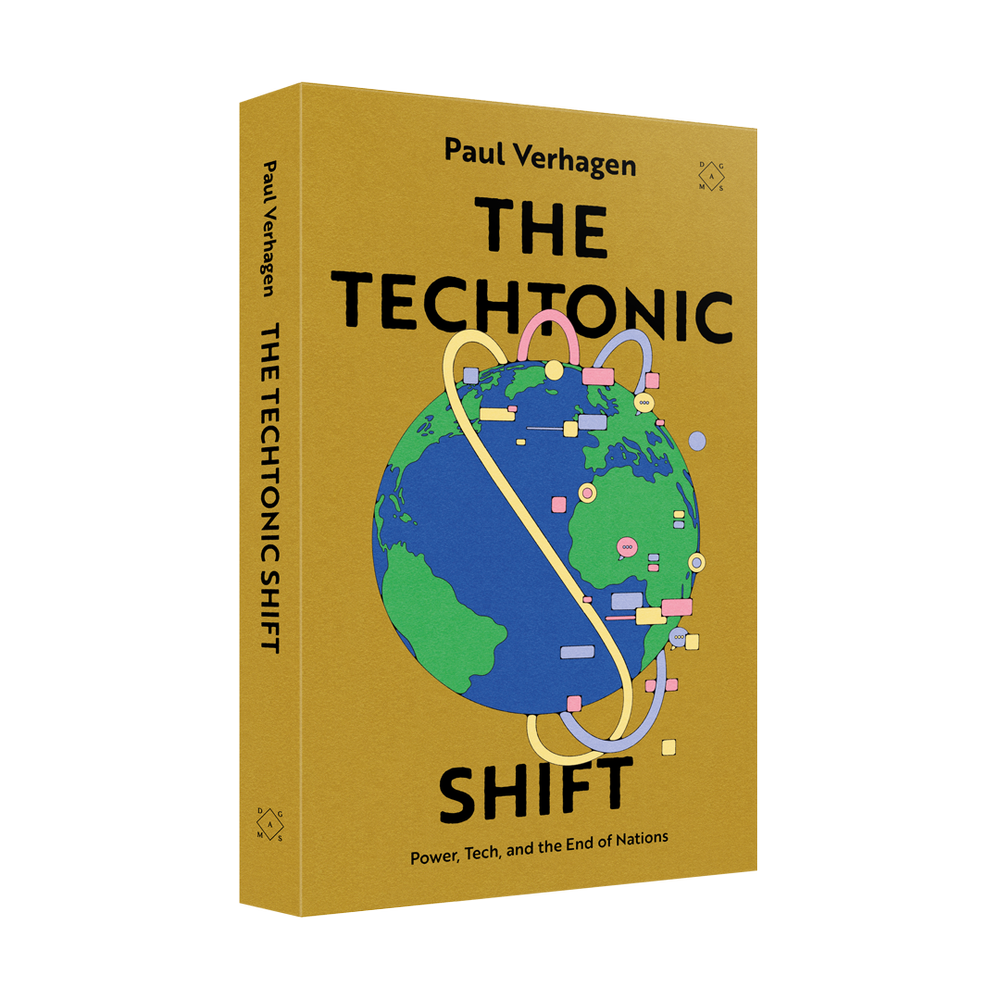
His forthcoming book, The Techtonic Shift, attempts to make sense of the moment we are living through: the breakdown of the globalised order that shaped the past three decades, and what comes next. We spoke to him about what that breakdown means for European business – and for the Netherlands specifically.
You talk about the end of what you call digital Pangea. What do you mean by that?
The world that my generation grew up in was essentially a digital super-continent. When the Soviet Union collapsed, borders dissolved, enemies disappeared, and technology became the great unifier that connected markets, cultures and economies. Pokémon is actually a good example: a niche thing that emerged in Japan, dovetailing with globalising information markets and consumer electronics, to become a worldwide phenomenon. That was only possible because technological dissemination and commercial incentives were perfectly aligned. Technology was a market.
All of that is changing. We are seeing the return of great power competition, and technology – instead of being a unifier – is becoming the dividing line for a new world order. This digital Pangea is breaking up. And because of what I would call catastrophic mismanagement by the United States, it has not split into a Western and non-Western bloc as expected. It has split into three: the United States, Europe and China. That is what the book is about: the tectonic forces pulling the world apart into new power blocs that are very reminiscent of the Cold War.
During your talk at the ICC Netherlands General Assembly, you said that Europe is facing three simultaneous threats. Is this a temporary crisis or something more structural?
Europe is facing a strange combination of factors. The Treaty of Maastricht built Europe as a pacifist free trade project; it made a huge amount of sense at the time, because there were no security threats and globalisation was the prevailing logic. However, we now live in a world that is neither pacifist nor committed to free trade. The two fundamental pillars of the European architecture no longer describe the world we are operating in.
Europe is not ready for these three distinct but interconnected threats. There is the military threat from Russia. There is economic pressure from China, which has hollowed out significant European industrial capacity through market dynamics. And, probably the most shocking, is the technological threat from the United States. Europe needs to deal with all three of these civilization-altering challenges at the same time.
Can we dive a bit deeper into the technological threat from the USA?
Here’s an example: something as basic as collecting tax revenue has in many European countries become dependent on American IT infrastructure. Education, defence, healthcare, water, electricity: all of these have become contingent on technology that is no longer sovereign. For a long time, we assumed technology was neutral, that assumption of neutrality no longer holds. And with artificial intelligence, it holds even less, because AI requires you to codify what you consider moral behaviour – and what counts as virtuous is heavily contingent on culture, politics and interest.
You have argued that Europe should pivot toward China – including dropping tariffs on Chinese electric vehicles. Can you explain more of what is essentially a provocative position?
A simplified version of power politics is about a balance between the three entities of the United States, European Union, and China. A global order in which business thrives is generated when two out of those three are on the same side. For a very long time, this has been the United States and Europe.
However, the Americans have decided they no longer want this – meaning that we need a new global balance. Europe – essentially going through a messy divorce with the Americans – needs friends abroad, which means that China is the only option.
Another example: Europe needs to rearm. In order to rearm, you need industrial capacity, energy and raw materials; none of which Europe has in abundance. You also need to free up electrical capacity. Chinese EVs are cheap, qualitatively good, and more competitive than European alternatives. In fact, Europe has been protecting Volkswagen and BMW from them. But if you open the Wall Street Journal, the market is already telling you: you are subsidising a European product for which a superior alternative exists. If you are going to subsidise something, surely it should be European weapons – not European EVs. So the logic is: buy Chinese EVs, free up European industrial capacity for defence, and use what China actually wants, which is access to ASML – as leverage for rare earth minerals.
Europe might need to deal with the Chinese even if they don’t want to – these are the kinds of hard strategic choices that the end of the neoliberal era forces you to make.
Both your talk at ICC NL and your book mention a model for Europe called the ‘garden with high walls’. Can you briefly describe your thinking behind this?
There are three elements. First, the garden itself: the European standard of living. High levels of education and healthcare is genuinely aspirational. It is worth protecting. Second, the walls: Europe needs to keep out things that degrade its ability to sustain that garden.
For example, European governments rely so heavily on American tech companies. But as we can no longer assume American interests and European interests are aligned, this means that Europe needs to build its own alternatives. That starts with strategic autonomy in security, but very quickly snowballs into other adjacent sectors such as energy, education and healthcare. The closer something is to core strategic interests, the more important it is to have European alternatives.
The third element to the model are the gates, which is not some impenetrable barrier. Europe has a labour force problem; it cannot build what it needs without people. And right now there is an exodus of talent from both the United States and China – engineers and skilled workers who do not appreciate the political environment they are operating in and are looking elsewhere. Europe should become a beacon for that talent. Anyone willing to contribute to the defence of the garden should be welcomed through the gate.
The Netherlands sits at the intersection of all of this: deeply dependent on trade, a NATO member with strong ties to both the US and China, and home to ASML. Is that a strength or a vulnerability?
The Dutch are in an interesting place. Being so trade dependent, the Netherlands is a product of the neoliberal order. And then there is ASML, which is becoming both a blessing and a curse. On the broader level, technology has shifted from a commodity to the weapons sector. In a commodity system, only price and efficiency matter. In the weapons sector, what matters is control.
Since 2018, the Americans have been pressuring ASML not to sell to China. The Dutch went along with this in exchange for American commitment to NATO. However, that commitment has not materialised in the way that was expected. So now we need to ask a hard question: why are we withholding one of Europe’s most significant strategic assets for what appears to be very little European gain? And there is a further problem: by blocking Chinese access to EUV machines, we have created a powerful incentive for China to develop its own. The golden goose that is ASML may be degrading.
Europe is simultaneously pursuing the Chips Act, the Green Deal, the AI Act, the Mining Act and military rearmament. You have called this megalomania. Where should Europe’s priorities lie?
You cannot build everything at once. Take just three of the things on that list: military rearmament, an industrial mining complex to supply the raw materials for rearmament, and the Green Deal requiring both to be CO2 neutral. Building a mine in Scandinavia takes ten years and is environmentally damaging. By the time it is operational, you’re way too late with your military aims.
This is where China comes back into the picture. China can supply the rare earth minerals needed to accelerate European rearmament. You should also build the mine, but you should make a deal with China to accelerate your timeline. You buy their electric vehicles. In return, you negotiate on minerals. It helps the Green Deal, it helps rearmament, and it reduces the pressure on the Mining Act simultaneously.
The priority has to be strategic autonomy, starting with security, then energy, then education and healthcare. Not everything at once. For too long we have operated under the assumption that technology is neutral, which is now revealed to be a complacency. Technology shapes society, and therefore control over technology controls everything. Technology is a source of power, and the world is beginning to reorient itself around that realization.